
One of the things that has influenced me enormously in my TEFL career has been the fact that I come from a multilingual family, so I have never seen language learning as something scary or difficult.
My mother was born in Gdansk, which is now in Poland, but when she was born, it was an independent city state called Danzig, and the official language was German. My grandmother was Polish and my grandfather Danish. They both spoke Russian and English as well as their mother tongues, and communicated with each other in English. As a result, my mother grew up speaking Danish, English and German. When she was about eight years old, she was sent to boarding school in England because my grandparents didn’t want her to be forced into the Hitler Youth movement, but then in 1939, when she was 12, she was unable to return to school, and she and her parents fled to Copenhagen. She spent the next five years at a French convent school, where she learnt fluent French, and after the war she went to England to study French and German at university.
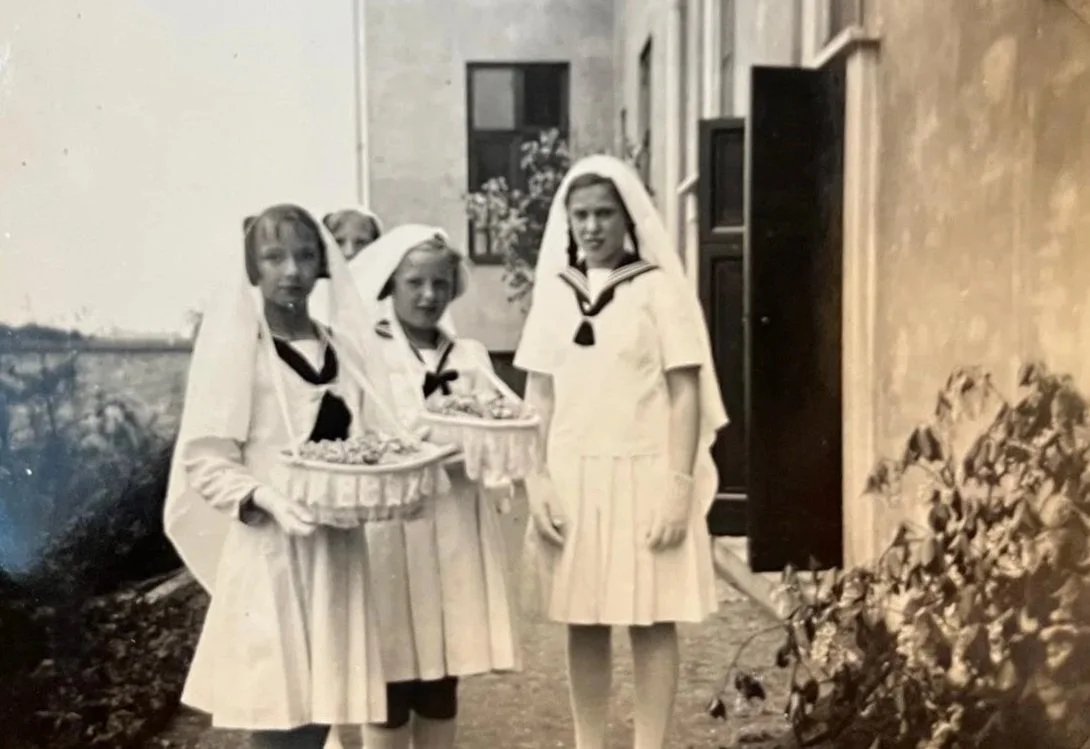
My mother at the French Convent school in Copenhagen, 1940
There she met my father, who was also a student. He had been born in Mauritius, and his first language was French, though as Mauritius was at that time a British colony, he also spoke English. In fact, he spoke with a slight French accent all his life, something I always felt was intentional, as he thought it sounded more attractive! My parents communicated with each other mainly in French, but sadly, they did not bring us up bilingual; there was a theory at the time, now completely disproved, that bilingual children never ended up speaking either language well. Instead, they used French as their private language. This, of course, motivated all five of us children, and later even some of our children, to learn French! By the time I finished university and moved to Spain, I spoke quite good French, and a bit of Spanish which I had learned at school.
I never went to Spanish classes, but picked up the language pretty quickly, and now speak and understand it as easily as English, though am a bit less keen on reading and writing. I think the ease with which I learned Spanish was very much influenced by growing up surrounded by languages – my parents’ friends when I was a child were frequently foreigners – and by the Latin I had studied at university. However, just like my father retained his French accent, I never lost my English one. At first, it used to irritate me when Spaniards would say to me, ‘How come you still speak with an English accent after living here for so many years?’, but I later realised that in fact my accent was part of my identity. I didn’t want to pretend I was Spanish – I was happy with my own nationality. This was something that influenced me a lot in the teaching of pronunciation, and I have always made a point of saying that having an accent and having great pronunciation are two completely different things. I was delighted when the Cambridge exams guidance for grading students on their pronunciation in oral exams removed the descriptor ‘native-speaker-like pronunciation’ from their top marks. I think that the only people who do speak more than one language without any accent are usually bilingual, so this too reflects their identity.
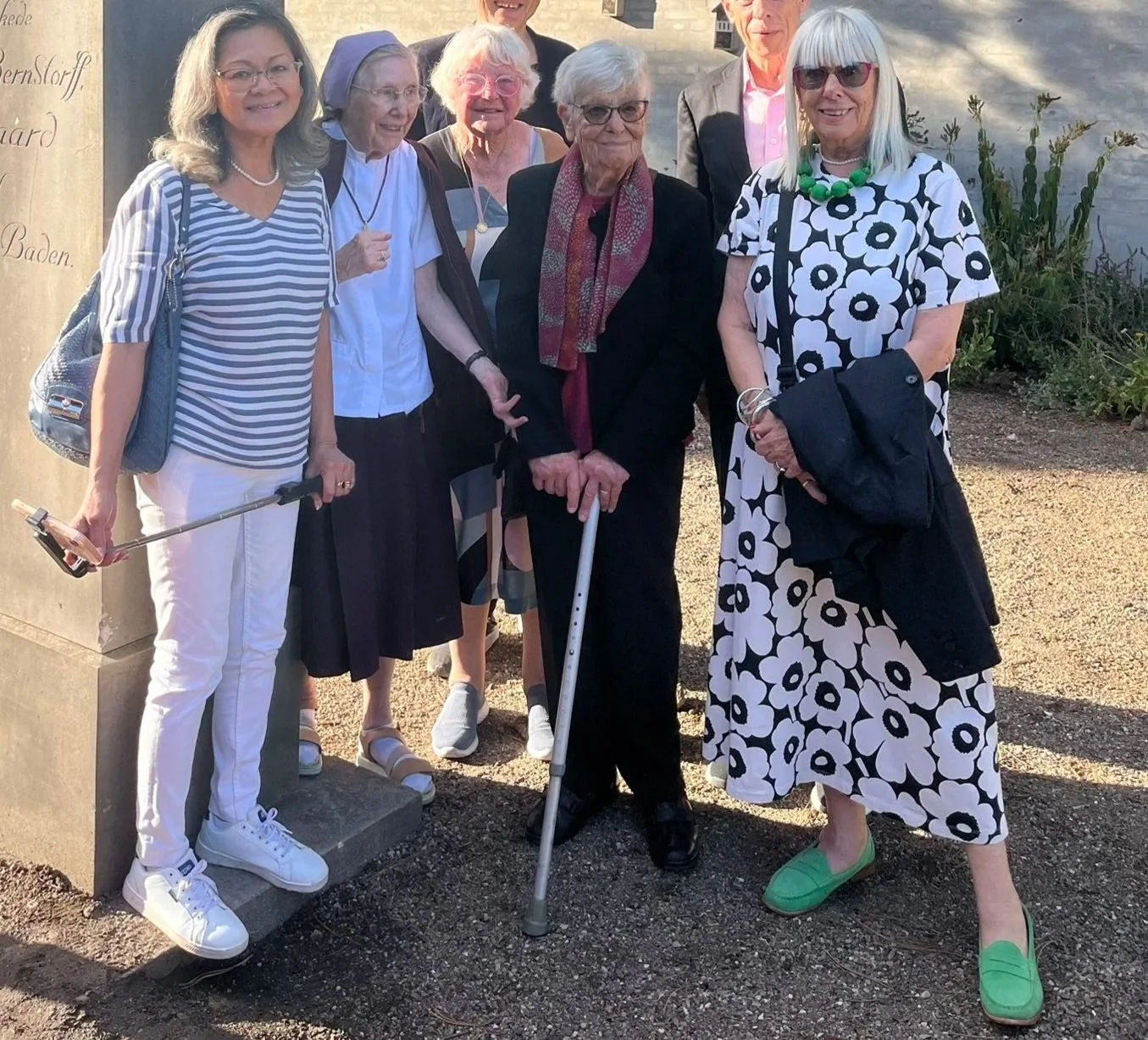
My mother (in the centre with a stick) aged almost 99 visiting the French convent in Copenhagen where she had been at school during the second world war.
Still on the subject of pronunciation, when I was writing English File, either the second or third edition, I started to have private classes in Polish, partly, because of my heritage, because I wanted to learn the language, but also partly because I wanted to know what it was like to be a complete beginner learning a foreign language. Although I found the grammar unbelievably difficult, the one thing I was good at was pronunciation, probably from having heard my grandmother speaking to her many Polish when I was a child.