
Mind the gap!
‘I’ve never been to Athens and I’ve never been to Rome…’ To my generation of teachers, that line would immediately send a tune racing through our heads, and we would probably start tapping our feet. Brighton in the Rain. Cambridge English Course circa 1992, I think. When I started teaching adults, coursebooks sometimes included songs that had been specially written to illustrate a particular grammatical structure, or to help them students to learn vocabulary sets. None of them really stuck in my head, the way a really good song can do, however old, with the exception of Brighton in the Rain. It demonstrated the use of the present perfect for past experiences, and was both funny and catchy. Students loved it, and possibly it was using this in class that made me realise what a useful tool songs could be.
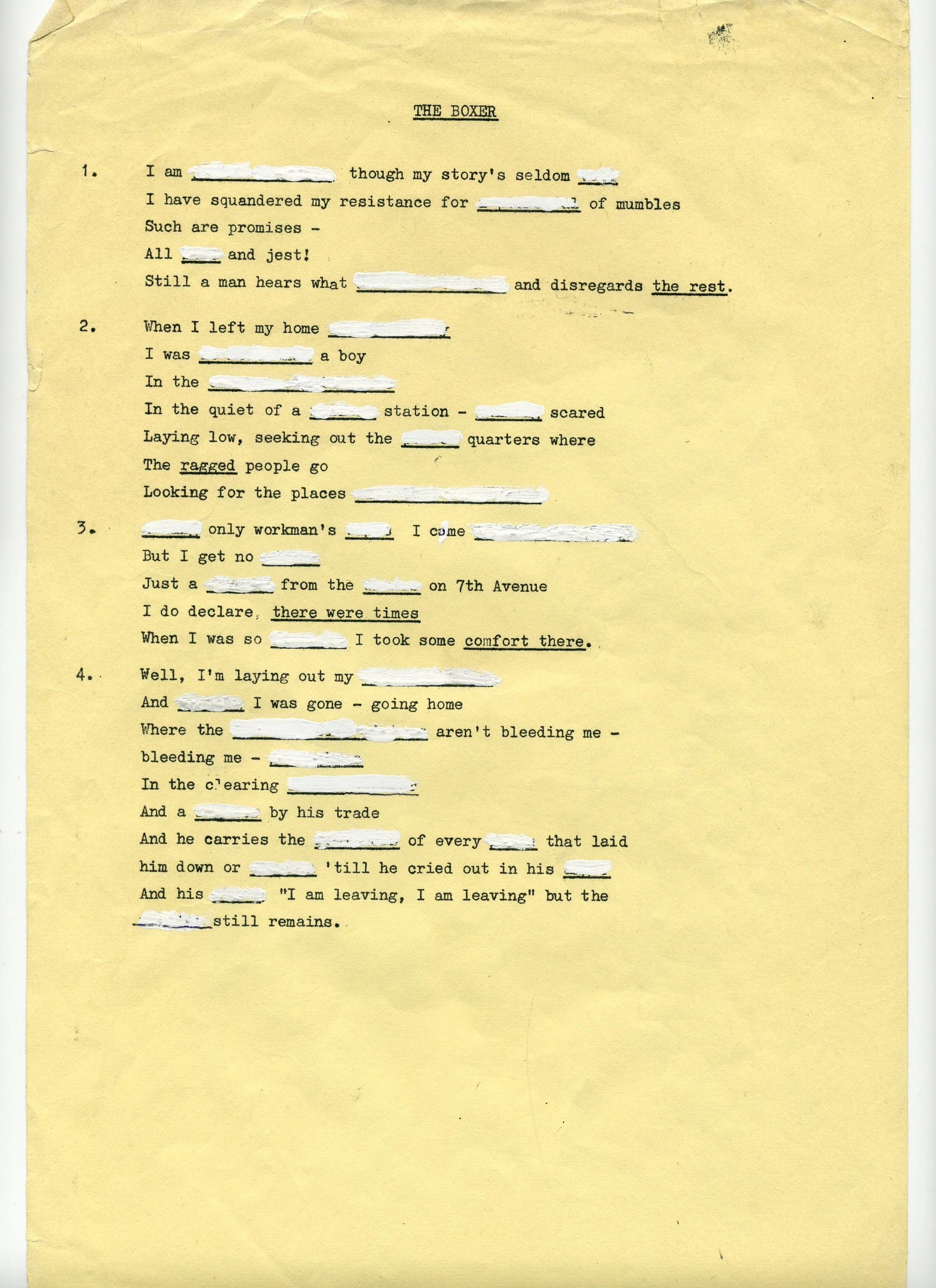
In the early days, creating a worksheet for a song was an extremely time-consuming business, and the tasks we produced were not always very satisfactory. In those pre-internet days, the only way to get hold of song lyrics was to play the track again and again and write them down – and even then, there was often a word or phrase that we just couldn’t identify. By the time we had finally agreed on the lyrics, we knew the song so well that we tended to make the tasks too difficult, having forgotten that when we heard the song the first time we almost certainly didn’t hear every word. One of Clive’s first song sheets was for The Boxer, by Simon and Garfunkel. He typed the lyrics out, and then with a bottle of Tippex, created no fewer than 31 gaps! He told me that the first time he used it, students just looked blankly at him after he had played the song once – they hadn’t manged to fill in a single word! Some years later, we wrote a talk about using songs called Mind the Gap, and we started by showing Clive’s task (amazingly he had kept it). We played the first verse of The Boxer. None of the teachers had managed to complete all the gaps. They also wanted to know what ‘a pocketful of mumbles’ were, which taught us another lesson – don’t use a song unless you are prepared to explain or translate all the lyrics.
Given the abundance of great pop songs with really exploitable lyrics, we preferred to use these in class rather than trying to write our own, and when we started writing English File, we decided to include them. We chose songs either to go with the lesson topic or because they had good examples of the grammar or vocabulary we were teaching, rather than just because they were current, or good songs. We used the original songs where we could, produced cover versions where we weren’t allowed to use the originals, and created worksheets for them all. In general, the songs were very popular, though teachers often complained that they weren’t recent enough. What they didn’t know was that it was extremely difficult to get permission just to print the lyrics of pop songs, let alone to include the original recording. This was something we did occasionally achieve, though in fact the cover versions we usually ended up using were in general very good.
Choosing songs was perhaps the only aspect of English File about which Clive and I sometimes argued, each trying to convince the other that one of our favourite songs would work brilliantly. There was also the question of convincing OUP. Clive and I were fans of Bob Dylan, and we once wrote a great task to exploit his song Hurricane to go with a lesson about crime. We were convinced it would be a great success, until our editor pointed out that the song lasted exactly 8.33 minutes, and by the time the teacher had played it twice and students had done the task, the lesson would be over. Our real favourite singer was Leonard Cohen, but however much we tried to persuade our editors that his songs would work well they never agreed with us. Perhaps they were right, but I still love listening to Leonard Cohen.
By the time we got to write 4th editions, we realised that what with the availability of both songs and song lyrics online, teachers could now easily write their own tasks for songs which they knew that their students would enjoy, and probably play a video in class rather than just using audio. It had also become even more difficult, not to mention expensive, to obtain the rights, so it was decided not to carry on including them. In a way I was sorry, but I did feel that at least we had provided teachers with many examples of activity types to use, and they now probably create much more appealing tasks for much more popular songs than we would ever have been able to use. But it was fun while it lasted, and I still love Leonard Cohen and regret never getting him in.