
I always check what it is in Polish
As I said in a previous blog, my grandmother was Polish; however, I had never been to Poland, as we no longer had any family there. So when I was first invited to come and give author talks there, I jumped at the opportunity.
One of the things that surprised me when I arrived on that first tour was how weirdly familiar everything felt. The sound of the language, the features of the people, and above all the food, because both my mother and my grandmother were amazing cooks, and used to make several typical Polish dishes. The OUP team I met in those years were wonderful. They made me feel so welcome, even though English File was really only just starting to take off. Many of the people I met on that first trip became friends, and we continue to meet up, even though they have moved on from OUP. Sadly, one whom I have not seen for many years was the amazing teacher trainer, Krzysztof Dabrowski, who on that first trip said to me, as we bonded over a swig from his flask of vodka, that he loved English File because ‘it had a soul’. That remains the biggest compliment I feel that the books have ever been paid. Krysztof had a stroke many years ago and had to retire, but I have never forgotten him.
I have returned to Poland many times over the years, and love being there. In one of the early trips though, after explaining that my grandmother had been Polish, I was told that it was a disgrace that I couldn’t speak any Polish at all, so I decided to learn it. My other motivation was that I wanted to know what it was like to be a complete beginner learning a foreign language, and to see whether that would help me when we started writing new editions of English File. I managed to find a Polish teacher who was prepared to give me classes – no mean feat in Valencia at that time – and started a series of weekly classes.
The one thing I was good at was pronunciation, probably from having heard my grandmother speaking to her many friends in Polish when I was a child. I found the grammar unbelievably difficult, but the way I think learning Polish influenced my later writing the most was as regards vocabulary. The first thing that I realised was that words which, because of my familiarity with romance languages, I had assumed were more or less universal, were completely different in Polish and other Slavonic languages. Take the word animal, for example (which is the same in French, Spanish and Italian apart from the pronunciation). In Polish it is zwierzę. It took me ages to learn things like months, numbers, days of the week – things I thought, because of my knowledge of other languages, I would find easy. This made me realise that when I was choosing what vocabulary items to focus on in a text, I was often ignoring words which are similar in French and Spanish, thinking that these would be easy for students. Nowadays, before assuming that a word will be similar in other languages, I always check what it is in Polish.
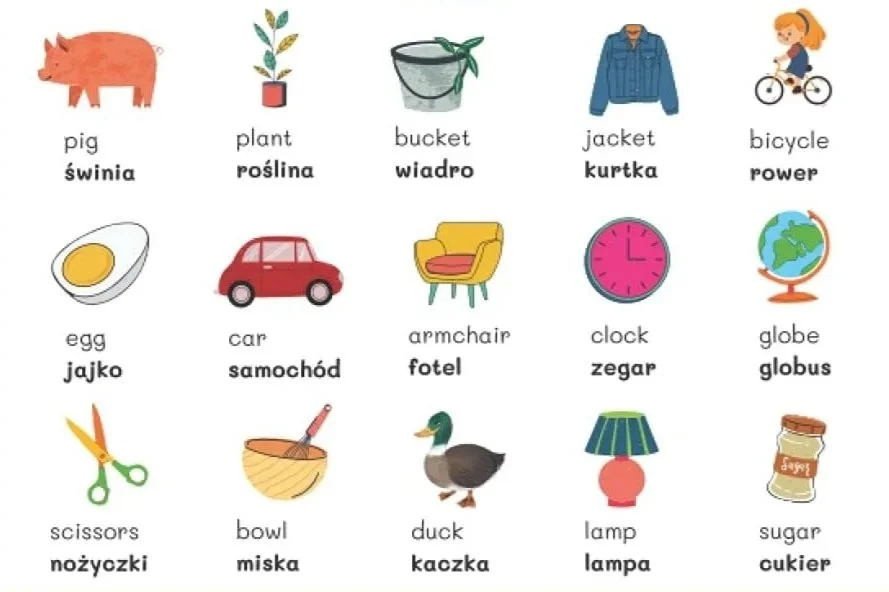
In another Polish class, we were doing colours. My lovely teacher Renata had prepared a beautiful worksheet for me with the colours painted down one side, and the words in Polish down the other. ‘Now’, she said confidently, ‘match the words and the colours.’ I looked at the words. There was only one that I recognised, possibly because of seeing it on menus with wine, and that was ‘red’, czerwony. I drew a line from it to the red blob. ‘Well done’, Renata said. ‘Carry on.’
‘I can’t’, I answered, ‘I have no idea what any of the other ones are.’
‘Go on, try’, said Renata, as I have said so often to my students.
I tried. The only thing I could guess at was zielony, which looked and sounded a bit like ‘yellow’. It turned out to be ‘green’. At which point, I gave up.
From then onwards in our Beginner level, we never ever asked students to match words and pictures. We presented the words with the pictures, and then practised and recycled them in other ways. I have never reached higher than, being optimistic, A2 level in Polish, but one day I’ll go there and do an intensive course, and hopefully get to B1!